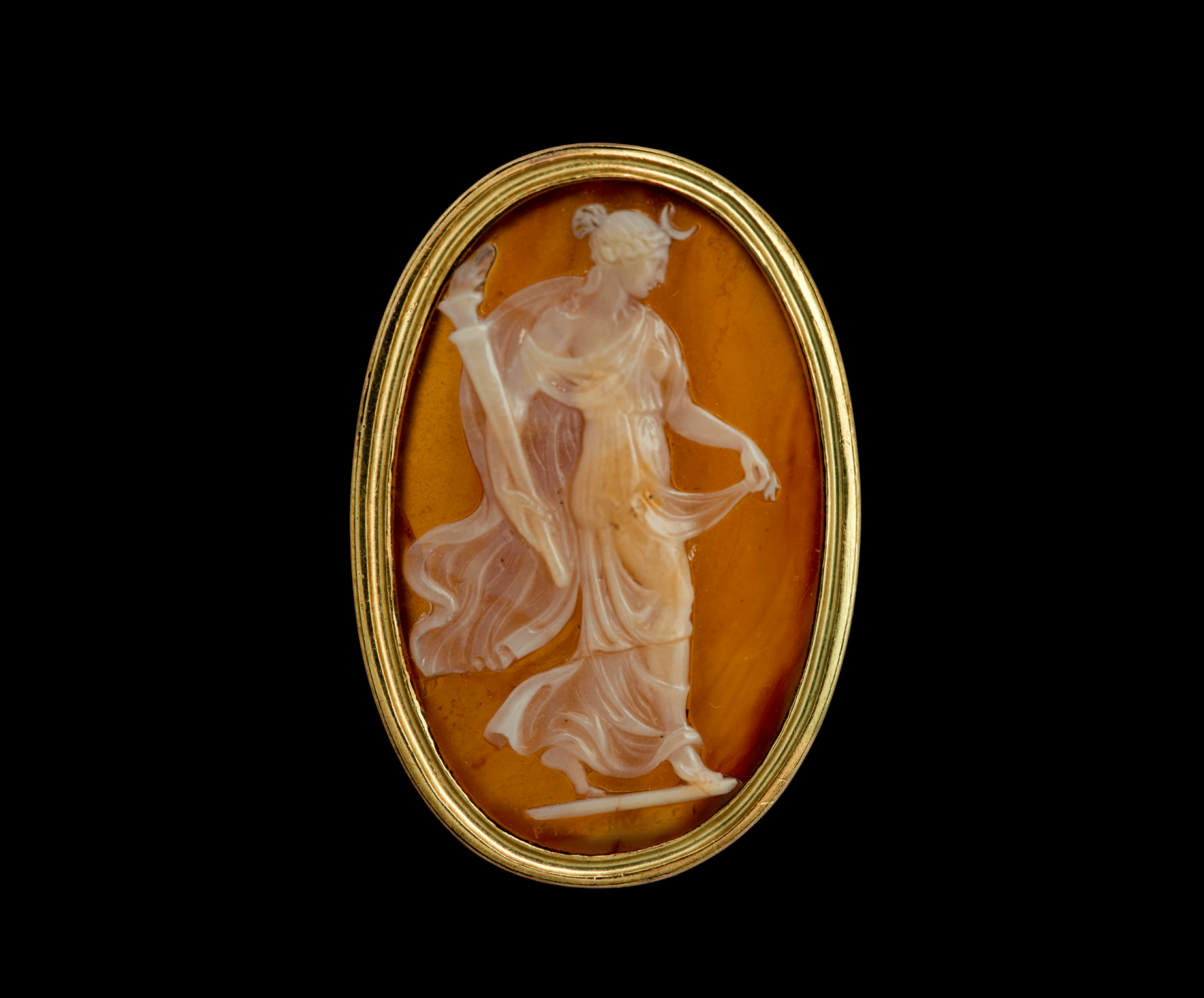
Benedetto Pistrucci
(Rome, 1783 - Englefield Green, 1855)
Selene
Two layers carnelian, 36 x 25 mm
Signed: “Pistrucci”
Period
Roma, ca. 1810
Bibliography
One of the most famous engravers of hard stones and medalist throughout the 19th century, Pistrucci was born in Rome in 1783. His family, of Roman origin, moved to Bologna from where his father, a court judge, was forced to leave after the arrival of the French in 1796, for his role in the trial against the patriots Luigi Zamboni and Giovanni Battista De Rolandis. It was therefore in Frosinone, where the Pistrucci family first took refuge, that Benedetto initially trained, together with his older brother Filippo (1782-1859), with the painter Giacomo Mango. Back in Rome from 1789, he was here apprenticed to Giacomo’s brother, the cameo engraver Giuseppe Mango. He, furthermore, studied painting with Stefano Tofanelli (1750-1812) and attended the Drawing Academy in Campidoglio, where in 1800 he obtained the first prize for sculpture in the competition of the roman’s Scuola del Nudo (School of the nude).
Later, he continued the cameo engraving business with Nicola Morelli (1771-1838) but soon, at the age of sixteen, he decided to set up on his own. In Rome he worked on the production and restoration of cameos and then spent a couple of years at the Tuscan court.
After a short stay in Paris, he moved to London in 1815 to start working at the Royal Mint, the British mint. In just a few years he became one of the most popular artists in George IV’s London, creator of extremely popular works such as the Saint George and the Dragon engraved on the reverse of the English gold pound starting in 1817 (Fig. 3). In the 1820s he engraved some notable medals: those for the coronation of George IV in 1824 and of Queen Victoria in 1838 (Fig. 4), and those in honor of the Dukes of York and Wellington. He engaged for over thirty years in the creation of his masterpiece: the Waterloo Medal (Figs. 1, 2). He began working on this ambitious project in 1817 and obtained the final issues only in 1849. The Mint Museum of Rome preserves a considerable number of Pistrucci’s waxworks, first-hand sketches of his works to be made in metal or hard stone.
Reference bibliography
Reference bibliography
L. Pirzio Biroli Stefanelli, I modelli in cera di Benedetto Pistrucci (“Bollettino di Numismatica”), 2 vols., Roma 1989;
Ead., Benedetto Pistrucci, in Dizionario Biografico degli Italiani, vol. 84 (2015)